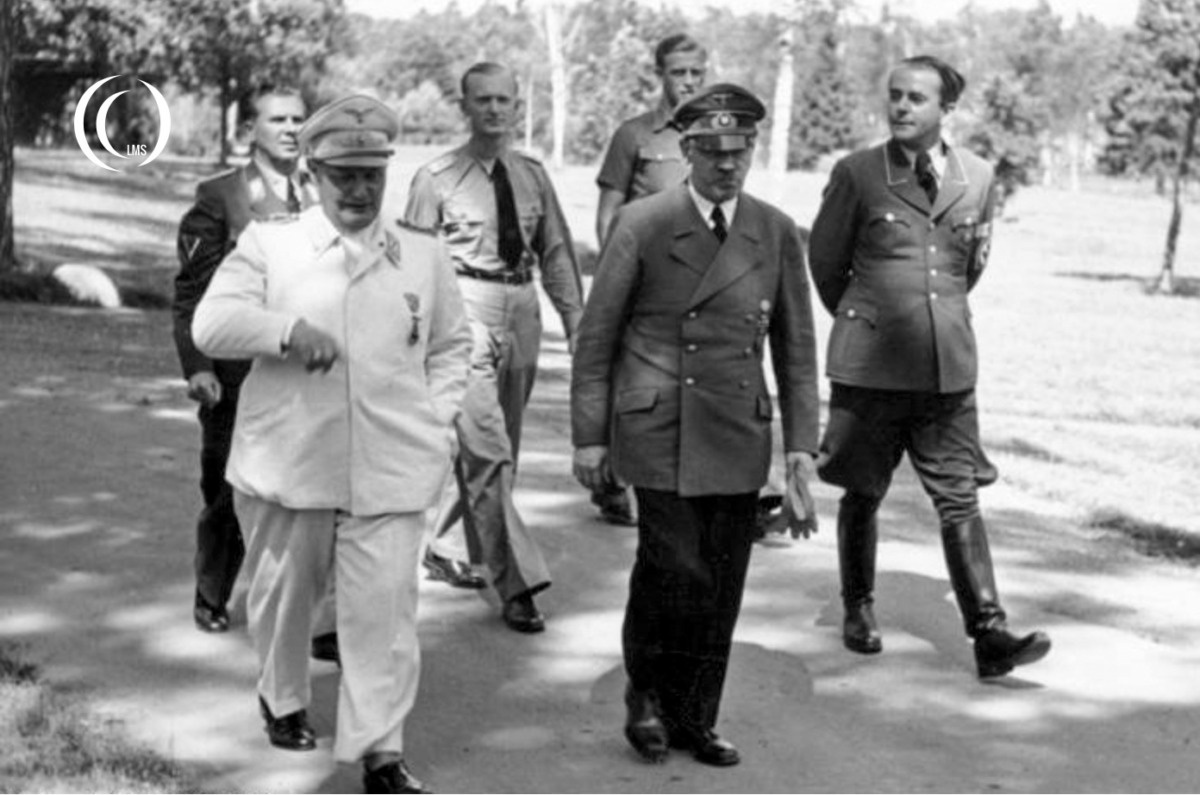
In April 1945, Nazi Germany is crumbling fast under the pressure of the Allied advance coming from two sides. From the West the Allies have crossed the river Rhine and from the East the Soviet Army has already reached the outskirts of Berlin. The fall of the Third Reich is inevitable. But in contrast to Adolf Hitler who is unwilling to leave his Führerbunker in Berlin, the second man of the empire, Reichsmarschall Hermann Göring, is far from planning to make his last stand.
On the 20th of April, Göring leaves his beloved Carinhall estate, named after his first wife, for the last time to attend Hitler’s 56th birthday in the Reich’s Chancellery in Berlin. He instructs a Luftwaffe Unit to destroy Carinhall when the Soviet Army closes in and has its, mostly stolen, art treasures transported by train to his other home on the Obersalzberg in Berchtesgaden in the South of Germany. It will also be the last time he and Hitler meet.
Escape to the Obersalzberg
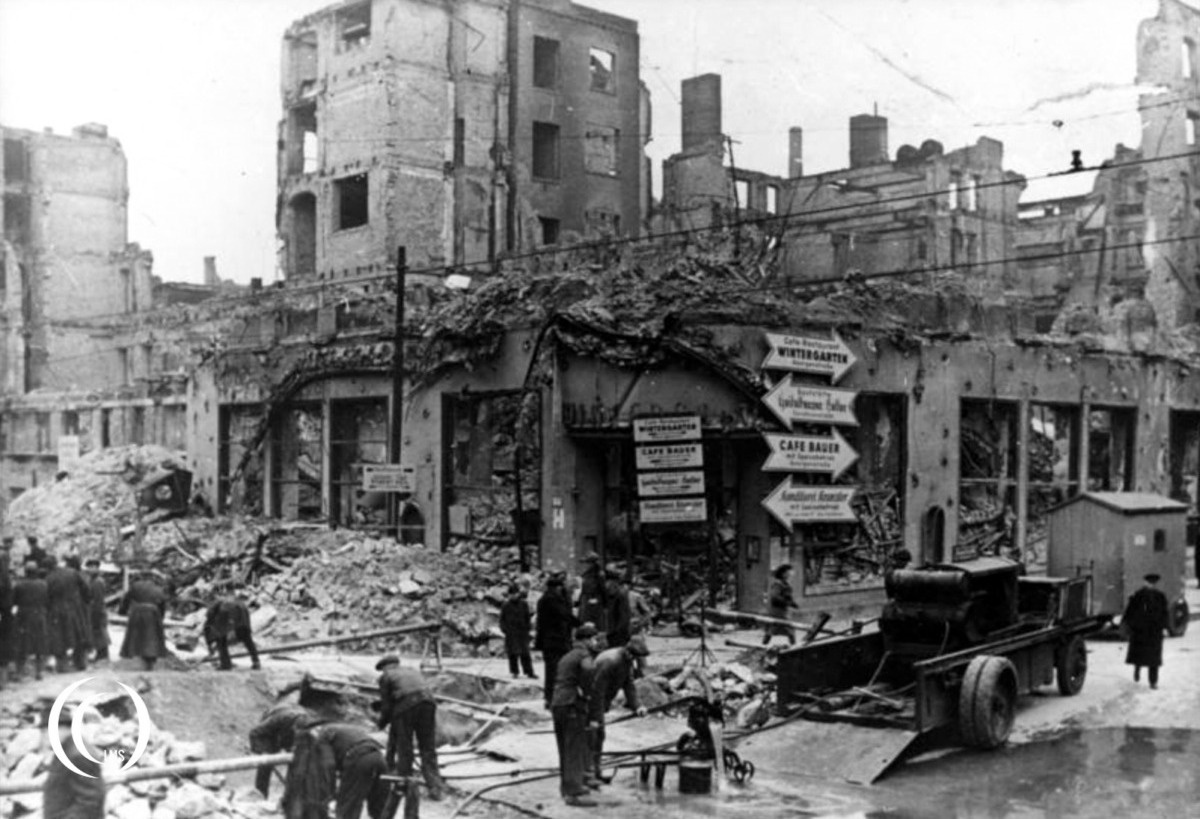
Berlin is under constant fire as the Soviet Army unleashes its wrath on the city. During his escape from the capitol, Göring is forced to go into hiding several times before finally reaching Werder Luftwaffe Headquarters, near Potsdam Southwest of Berlin. From here he is flown to Berchtesgaden.
When on the 23rd of April his Luftwaffe Chief of Staff Karl Koller personally brings him the news that Hitler has announced his suicide, Göring is unsure what to do. He has a signed decree in his possession drawn up in secret on the 29th of June 1941 and signed by Hitler himself, declaring him the first in command should anything happen to the Führer. But since his relationship with Hitler has deteriorated after the failures of the Luftwaffe, he doubts if this is still in effect or if the role has been delegated to his party rival Martin Bormann. He has the document checked by State Secretary Hans Lammers, who confirms its authenticity and then decides to act according to the decree.
Assuming Power
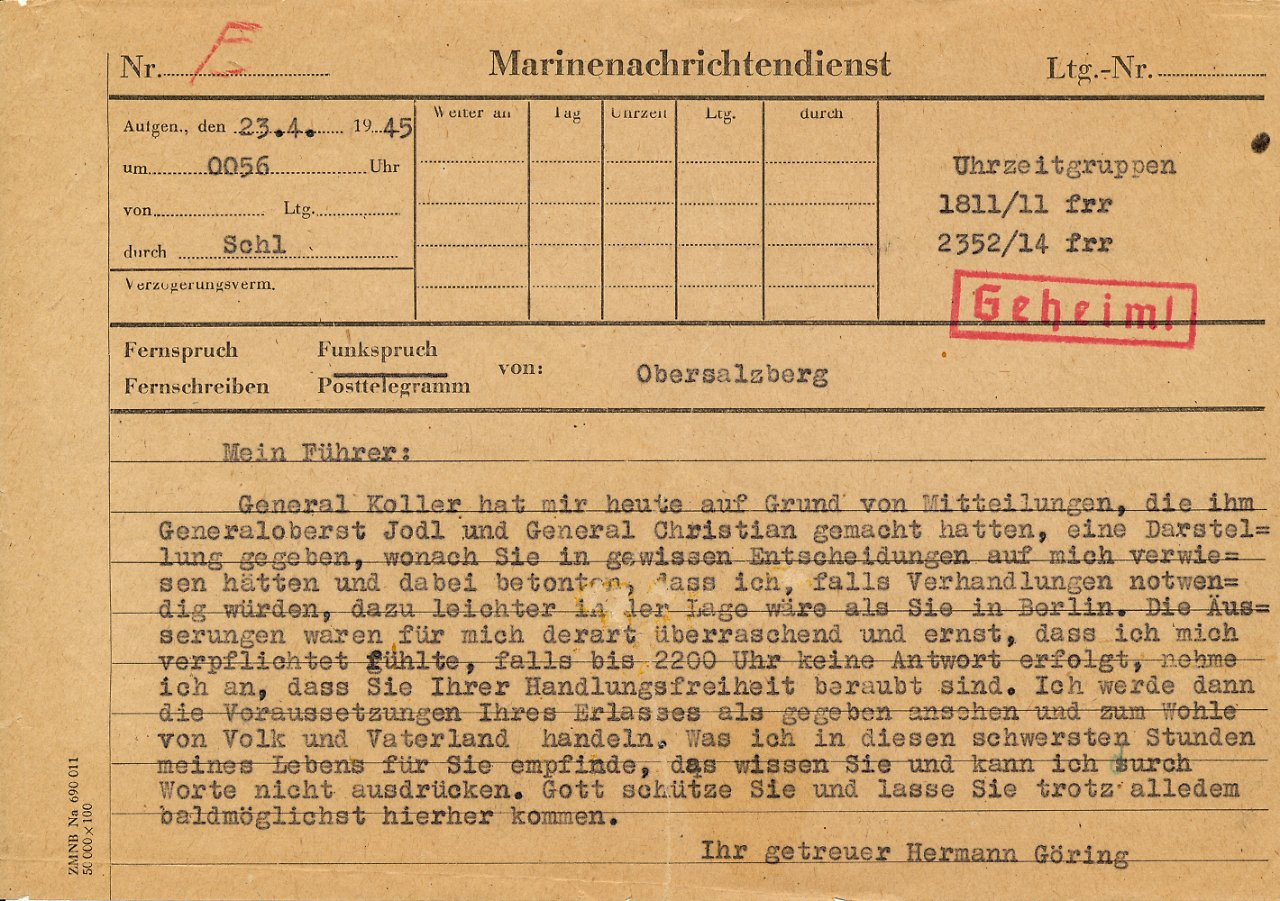
Göring sends a telegram to the Führerbunker in Berlin the same day, asking Hitler personally for his approval of assuming power conform the signed decree of 1941, together with an ultimatum for Hitler to respond before 22:00h. He immediately starts working on his plan and sends various other telegrams in preparation for the power takeover. Unfortunately Bormann intercepts the first telegram and takes it to Hitler, accusing Göring of high treason. But Hitler will not hear of it, until another telegram surfaces in which Göring orders Von Ribbentrop to come to the Obersalzberg after the ultimatum has passed. Hitler lights up in rage and accuses Göring of high treason. He sends Göring a reply in which he revokes the 1941 decree and forces him to resign immediately or face execution for high treason. The SS-command on the Obersalzberg is ordered to arrest Göring, together with his staff and Hans Lammers.
Göring is detained in his house until the Allied advance also reaches the peaceful Nazi mountain retreat on the Obersalzberg. On the 25th of April Allied bombers drop more than 1,200 tons of bombs on the mountain side. Most buildings, under which Hitler’s beloved Berghof are hit. Göring and his captors find shelter in the bomb proof tunnel system deep in the mountain. After the raid Göring is moved upon his own request to his castle at Mauterndorf further South awaiting his fate. On May the 5th he is set free of his SS guards by a passing Luftwaffe unit, but he does not leave Mauterndorf castle until the 9th of May.
A meeting with Eisenhower

Göring wants to contact the Americans and negotiate. He wants to talk to Eisenhower “from man to man” and proposes Schloss (Eng: castle) Fischhorn for the meeting. When on May the 7th Luftwaffe Chief of Staff Koller informs Göring the Americans are prepared to send US officer Brig. Gen. Robert J. Stack to speak with him, Göring reluctantly accepts.
On May the 9th Koller waits for Göring at castle Fischhorn. But when Göring still hasn’t arrived later in the afternoon he calls to Mauterndorf only to hear that everyone has left the castle at 12:00 from the caretaker. Fearing Göring is stuck in the columns of fugitives and retreating German forces moving West, he decides to drive into his direction.
Schloss Fischhorn

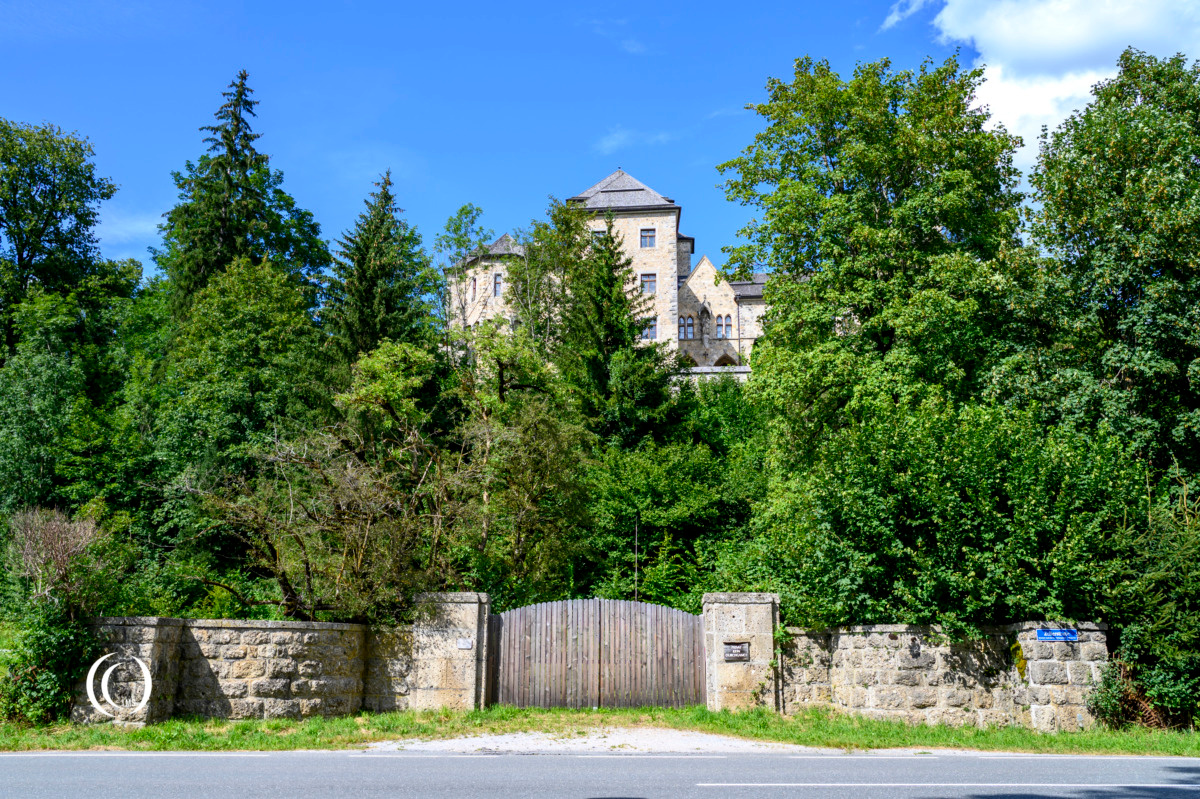
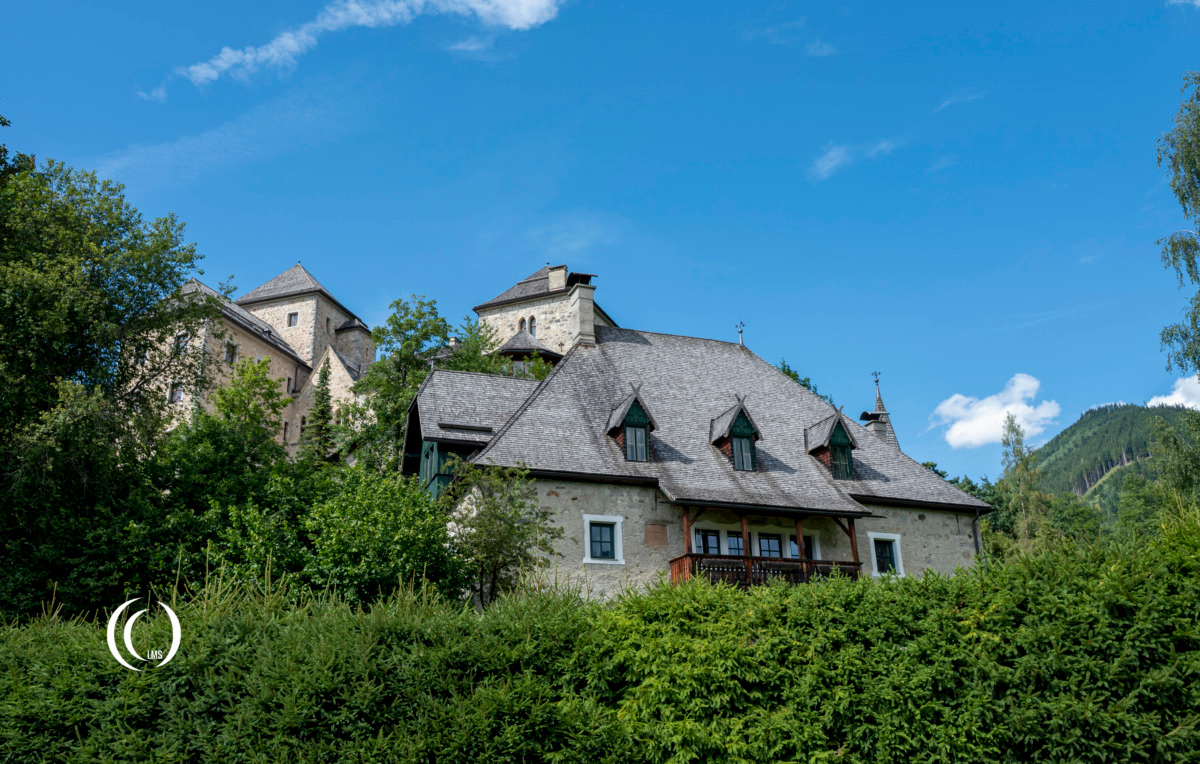
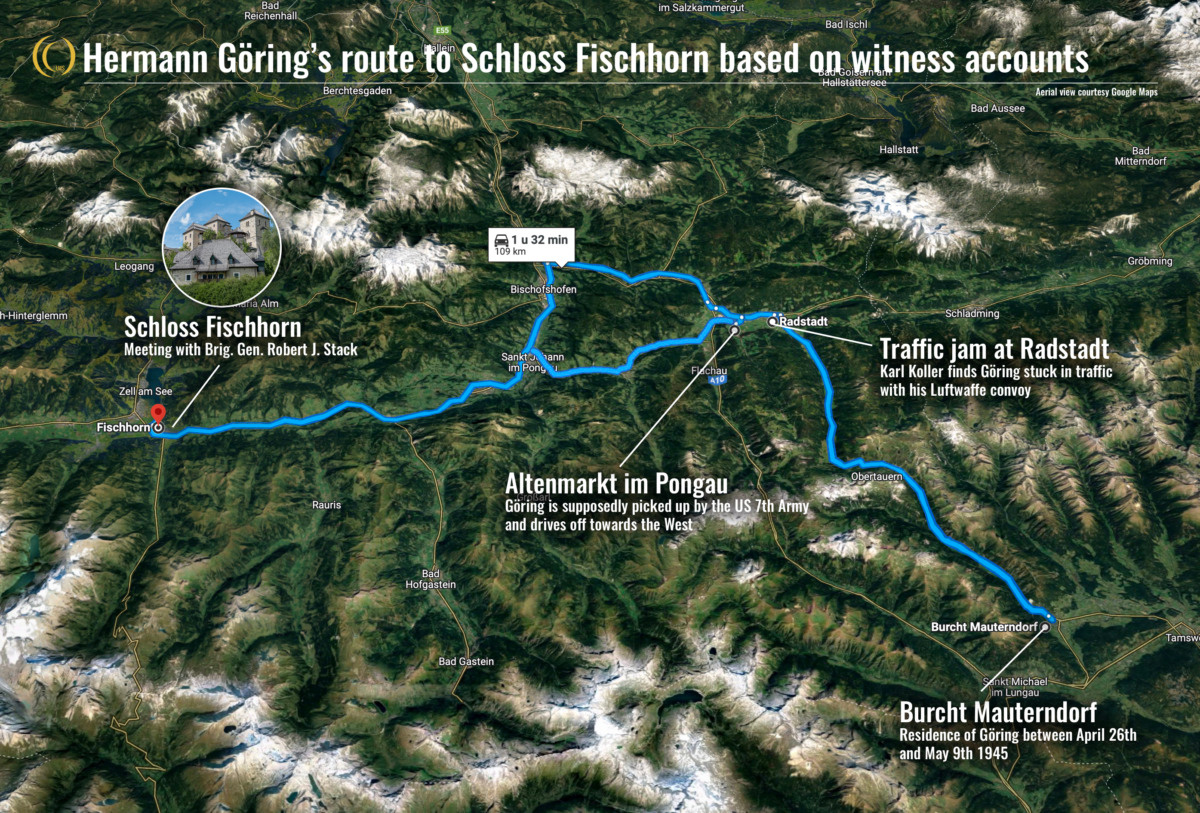
Although Koller manages to find Göring, who is stuck in a traffic jam near Radstadt, it is unclear wether they went back to castle Fischhorn. Some sources say they travelled back to Fischhorn and that they met the US officials there later in the evening. Other sources say that Göring was picked up by members of the US Seventh Army along the road in AltenMarkt and was taken away in a limousine in the direction of Fischhorn, but ended up talking to Brig. Gen. Robert J. Stack in the Grand Hotel at Kitzbühel 50 kilometers further Northwest.
Underneath a map of the supposed route that Hermann Göring took to Schloss Fischhorn on the 9th of May.
Nazi treasure
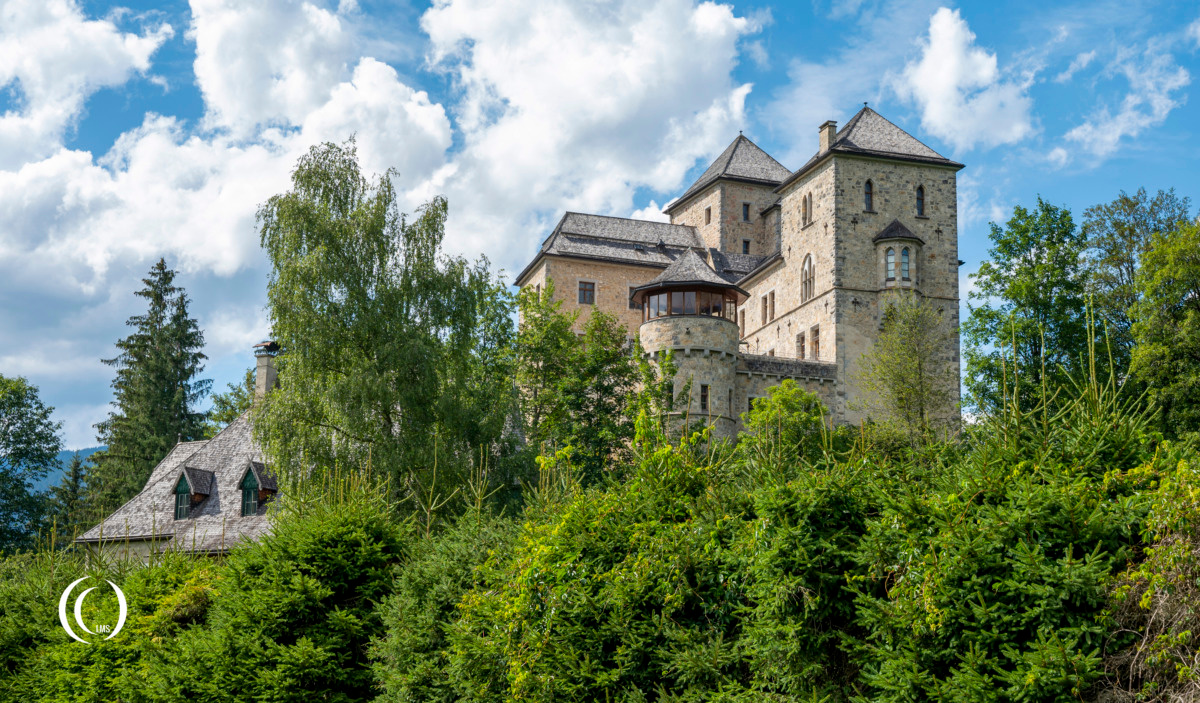
The fact that Göring mentioned Castle Fischhorn and wanted to meet Eisenhower there, could also have something to do with the Nazi art loot that was stored there. Most of it came from Poland, where it was looted during the Warsaw Uprising in 1944 on the orders of SS-Gruppenführer Hermann Fegelein. Sources claim that around 16 railway wagons of stolen art were brought to Fischhorn castle. But when the Americans took over the castle, they could only send back twelve railway wagons to Poland. In the days before, different witness accounts tell of soldiers and civilians coming and going and looting the castle.
In September 1945, officer Bohdan Tadeusz Urbanowicz was sent by the Polish Government to make an inventory and secure the stolen art. Even though many of the stolen items are recovered, Urbanowicz concluded in his report that a valuable part of the works was missing.
Years later works of art that had been stolen from Schloss Fischhorn turned up at American art auctions, probably taken home by US soldiers as a war trophy. But also in the area around Schloss Fischhorn, stolen works were recovered. In 2007, a precious 800-year-old Limoges cross is discovered in bulky waste in Zell-am-See-Thumersbach in Austria. It is identified as one of the missing pieces of the disappeared “Fischhorn castle loot” and returned to its owner in Poland. Until today the whereabouts of many items still remains unknown.
Nuremberg trial
Whichever is true, Hermann Göring was arrested by the US Seventh Army on May 9th 1945 and put on trail in Nuremberg, Germany, in 1946. He was found guilty on all four charges and was sentenced to death by hanging. The day before his execution, he committed suicide by taking a potassium cyanide capsule.

Visit Schloss Fischhorn
Today Schloss Fischhorn is privately owned. A few times a year guided tours are organized to visit the castle. You can also book holiday apartments for a stay in the castle through various tour operators.

Why doesn’t this article mention Lieutenant Shapiro, or the small unit of five men who went 400 miles behind enemy lines to capture him
My grandfather was one of those men. I also wish they were mentioned.
Hi Michelle – I tried to reach out to you just now but it didn’t go through. My Dad was in the 7th Army and I would like to have the opportunity to communicate with you. My e-mail is: Claredonfw@gmail.com
Linda King
Please let me know if you got my reply. Linda King – Claredonfw@gmail.com
Michelle, my husband’s grandfather was also one of those men, Col. Cader Terrell. Do you have other info you can share?
My father was one of those men who went with Lieutenant Shapiro behind enemy lines, I have a picture of my dad at Fischhorne Castle and with Goering and Stack.
That would be a fantastic photo to see! I have been to Schloss Fischhorn twice in the past – back in 2008 and in 2012, and have always been fascinated with this story.
The material on this page is most interesting to any student of these affairs, but it was written by someone who did (does) not know fluent English. It would benefit from the attentions of an English-speaking editor.
My family lived in Fischorn castle in the early 50’s. My father was a medic in ww2 and an officer in the army. I was young, around 10. We lived there for a couple of years. The top floor of the castle was full of art. Huge paintings in gilded frames. When I read about those years the story is the art was gone. But the top floor was stacked full of art while we were there. We were occupying Austria at that time. There were 3 other Army families there, A few maids, and their families, and a handyman.
Hello Karen,
I am excited to see your comment. I, too, lived at Fischorn, “the Castle”, as my mother would say. It was in 1948-1950; I was 3-5 years old, so I don’t remember much. But I remember Hans and Hansi the handyman, and our housemaid. Also Herr Luxa the bartender at the Officers’ Club– now the Grand Hotel. Hans taught my mother to drive a 1947 VW.
I recently visited Zell am See, and stayed at the Schloss. The outside and courtyard were familiar, the inside not so much. It was a very pleasant stay–not luxurious, but perfectly comfortable. Certainly worth it if you can make it.
Driving around Zell is a nightmare; a roundabout every few meters and traffic of biblical proportions. ; )
Thank you for leaving your comment; yours is the first reference to Zell am See and Schloss Fischorn that I have seen.
All the best,
Beverley (Stokinger) Seiter
Hello Karen,
I was so excited to see yours post. It is the first reference to Zell am See and Schloss Fischorn from a former military dependent that I have ever seen.
I lived at the Castle from 1948-1950, from 3-5 years old. Don’t remember much, but Hans und Hansi, our handyman and maid. Also Herr Luxa at the Officers’ Club bar– now the Grand Holtel.
I am recently returned from a trip to Zell, during which we stayed at the Schloss. Very moving and very much what I remember. It was a lovely stay–not luxurious, but very comfortable. Certainly worth it if you can make it. A very nice man named Michael took care of us.
Incidentally, driving in Zell is a nightmare, so prepare to have a GPS and a bit of patience, and hopefully a navigator you trust. : )
All the best,
Beverley Stokinger Seiter
My sister in law lived there as a young child at that time as well. Her father was an army officer , Gus Mastricola.