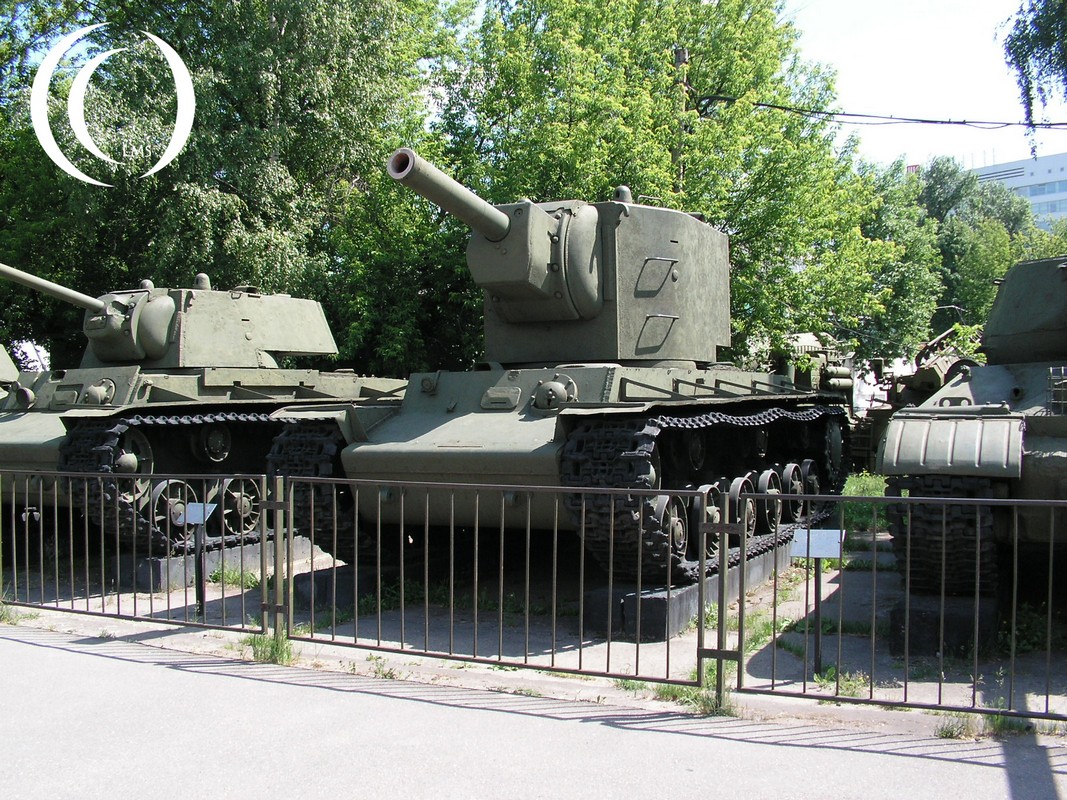
The KV-2 was one of the most distinctive and formidable heavy tanks fielded by the Soviet Union during the early stages of the Second World War. Officially designated the Kliment Voroshilov 2, it was developed as a specialized variant of the KV-1 heavy tank. Its primary purpose was to destroy fortified positions and bunkers, a need identified during the Soviet–Finnish Winter War of 1939–1940. The KV-1’s armor proved effective in that conflict, but its main gun lacked the destructive power to neutralize entrenched fortifications. To address this, Soviet engineers mounted a massive 152 mm M-10 howitzer atop the KV-1 chassis, resulting in the creation of the KV-2.
The most striking feature of the KV-2 was its enormous, box-shaped turret, which towered above the hull and earned the tank nicknames such as “Dreadnought” and “Mobile Pillbox.” This turret allowed the howitzer to be operated effectively, but its huge size also created significant drawbacks. It added substantial weight, raising the tank’s total mass to around 52 tons, and drastically increased its silhouette on the battlefield. The KV-2 became easy to spot and target, especially on open terrain. In terms of protection, the KV-2 was impressive for its time. The hull bore the same thick armor as the KV-1, ranging from 75 mm to 90 mm. In 1941, most German anti-tank guns struggled to penetrate it except at very close range. This enabled KV-2 crews to withstand substantial enemy fire. However, the vehicle’s heavy armor and turret also placed tremendous strain on its engine and drivetrain, leading to frequent mechanical failures—especially under harsh battlefield conditions.
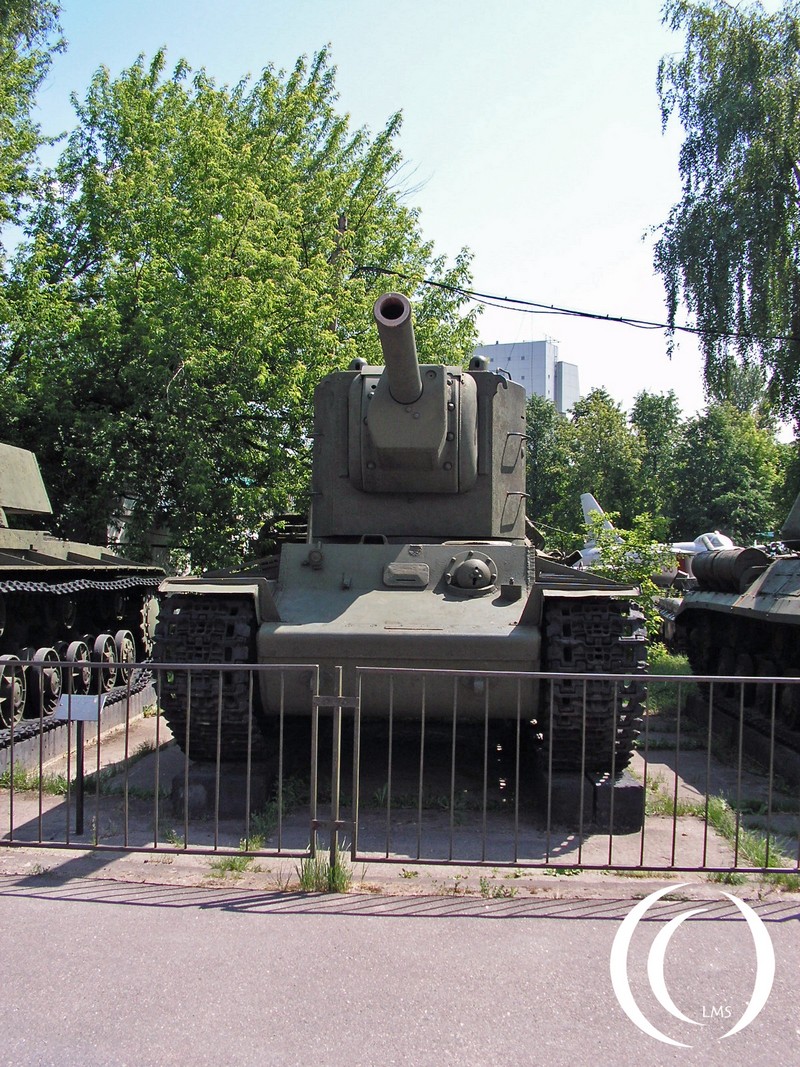
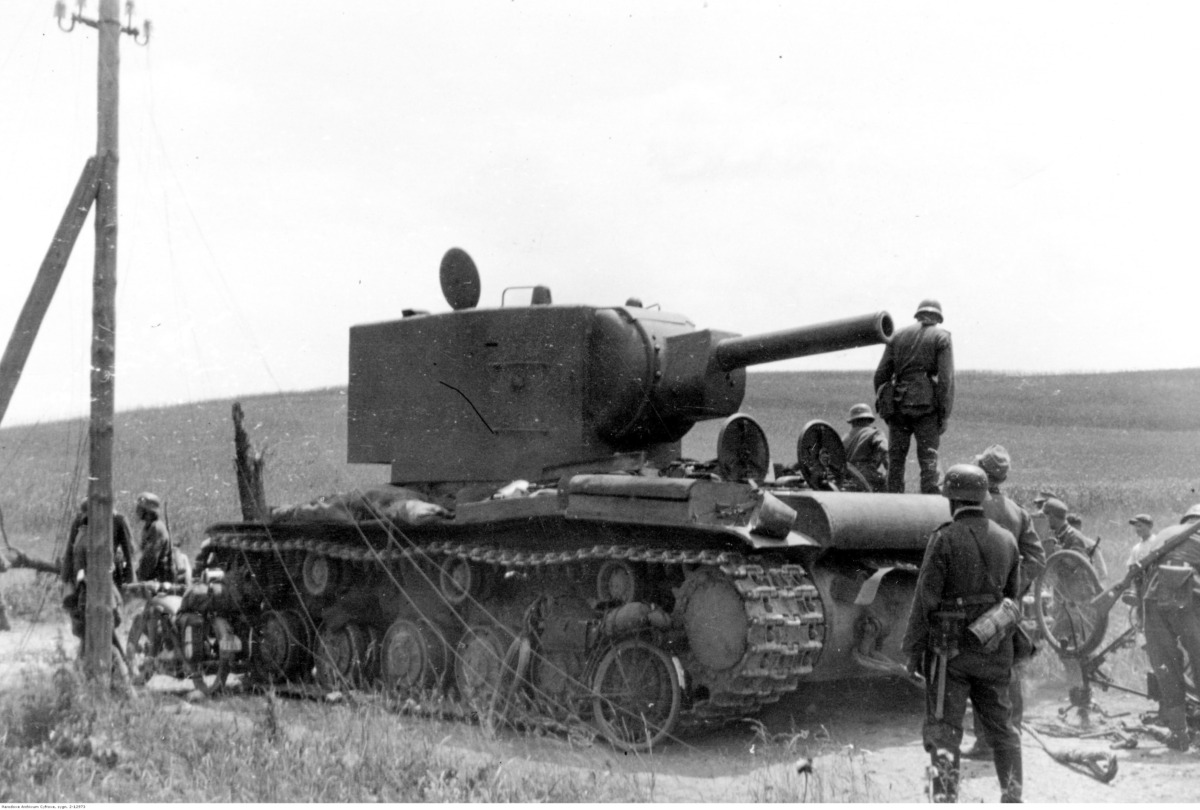
The tank’s 152 mm howitzer delivered devastating firepower. It could demolish bunkers, buildings, and enemy artillery positions, and its high-explosive shells were capable of incapacitating even the heaviest German tanks of 1941, such as the early Panzer IVs, through sheer blast force. Yet the howitzer had limitations. Its slow rate of fire and limited ammunition storage made the KV-2 ill-suited for fast-paced tank engagements. Furthermore, the massive turret had very slow traverse, and on sloped ground, it sometimes could not rotate at all due to balance issues. When Germany launched Operation Barbarossa in June 1941, the KV-2 was among the Soviet Union’s most intimidating armored vehicles. Several early engagements became legendary, with isolated KV-2s holding up entire German units for hours. In one famous incident near Raseiniai in Lithuania, a single KV-2 blocked a key road and withstood repeated attacks from German tanks, artillery, and anti-tank guns before finally being disabled.
Despite these dramatic successes, the KV-2’s shortcomings became increasingly clear. Its mechanical unreliability, logistical demands, and slow performance made it unsuitable for the rapidly evolving nature of armored warfare. By late 1941, production was halted with fewer than 250 units built (204 according to Russian sources), and the Soviets focused instead on improving more balanced designs.
Specifications
The KV-2 was a massive Soviet heavy tank, famous for its huge M-1938 152mm howitzer, built on a KV-1 chassis, featuring thick armor (up to 110mm), a large, bulky turret, and slow speed (around 25 km/h), but packing immense firepower for breaking fortifications, crewed by 5-6, powered by a V-2 diesel engine, weighing over 50 tons.
KV-2 Specifications:
Dimensions: 6,76 m long, 3,32 m wide and 3,45 m high for the early versions, 7,1 m long – 3,32 m wide and 3,24 m high on the late versions
Main Armament: 152 mm 1938/1940 L20 howitzer on the early versions, 152 mm M-1938 howitzer (M-10T) on late versions, both with 36 rounds
Secondary Armament: 2-3 x 7.62 mm DT machine guns with 8000 rounds.
Armor: 75 up to 110 mm on hull and turret front.
Weight: Around 52 tonnes (early version) – 58 tonnes (late version).
Crew: 5-6 (Commander, Gunner, Driver, 2-3 Loaders/Radio Operators).
Engine: V-2 diesel (500-550 hp).
Top Speed: 25 km/h (road), 12 km/h off-road.
Range: 140-200 km (road).
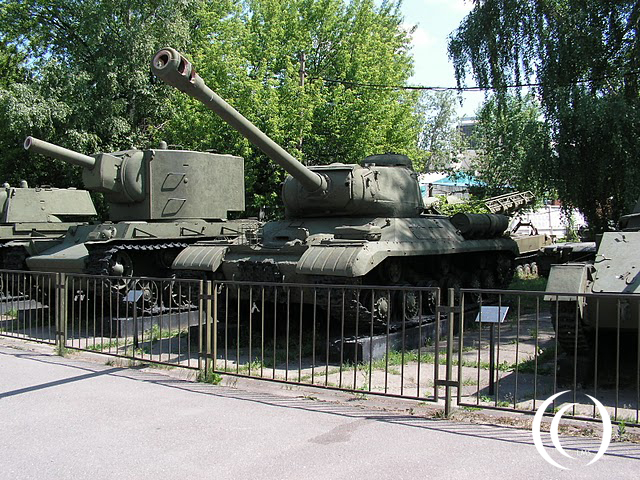
There is only one original KV-2 tank left, this sole survivor can be seen in The Central Museum of the Armed Forces in Moscow. This KV-2 in the photos, serial number B-4744, is one of the last produced in June 1941. The road wheels are from a later KV-1, and the tracks are from a T-10 tank. The T-10 from 1953 (also known as Obyekt 730) was a Soviet heavy tank. Its design was based on the Russian heavy IS-3 tank.
